Robotics · 22 November 2026 · 4 min read
Texas A&M Opens $200 Million Space Institute Near NASA JSC With Lunar and Martian Robotics Testbeds
Situated next to NASA Johnson Space Center, the new research complex gives aerospace and defense robotics teams indoor lunar and Martian terrain to validate off-road autonomy.
Lede & Nut Graf
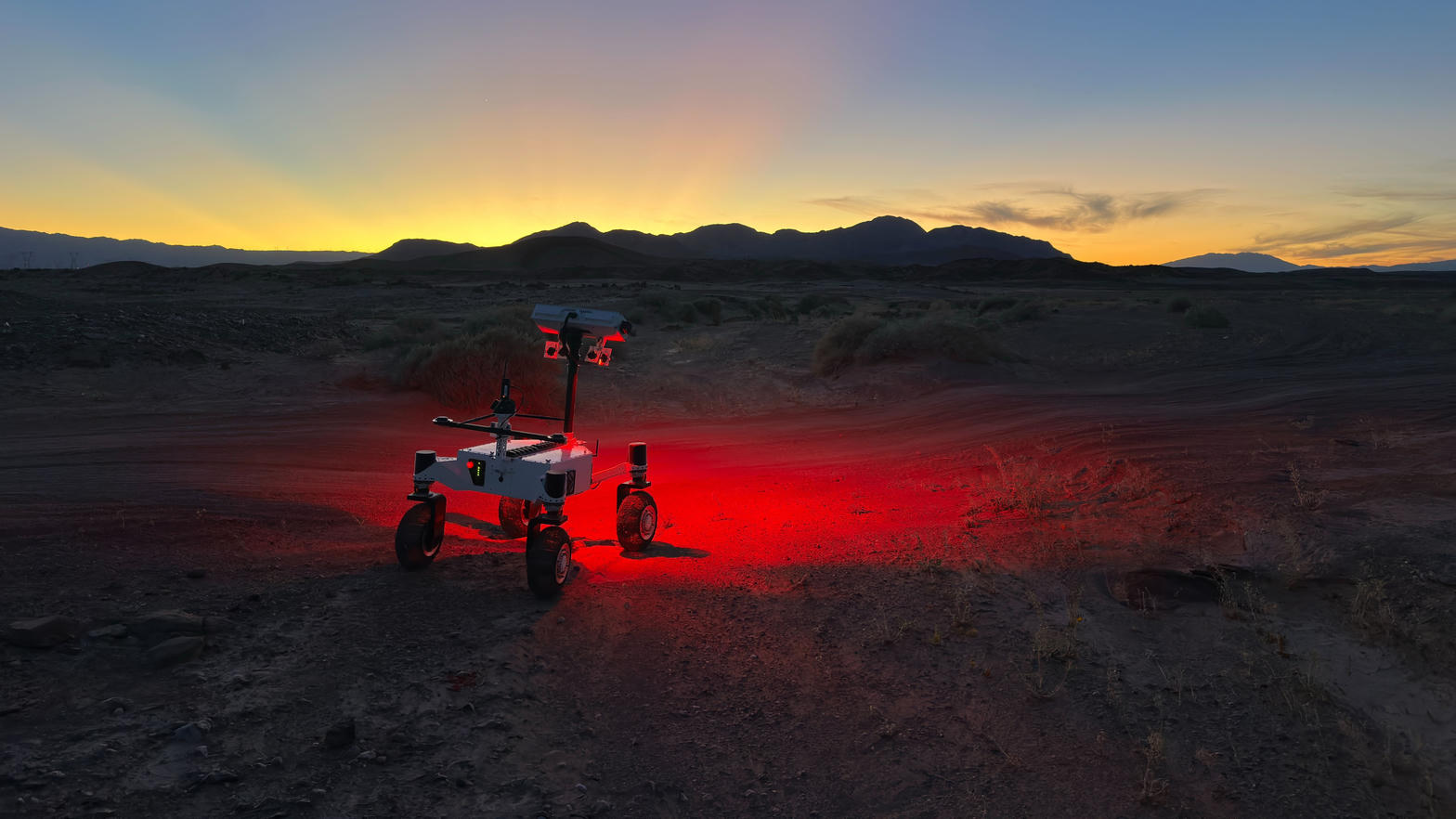
Texas A&M University has opened its $200 million Space Institute near the National Aeronautics and Space Administration’s (NASA) Johnson Space Center, adding dedicated indoor lunar and Martian terrain testbeds engineered for autonomous robotics validation (CASRAI, Nov. 21, 2026).
While most commercial Physical AI headlines center on wheeled warehouse robots and flat factory floors, defense, mining, construction, and cislunar logistics require machines that can navigate unstructured, high-slip terrain without human teleoperation. Purpose-built physical testbeds bridge the stubborn sim-to-real gap where synthetic physics engines still fail to model granular soil mechanics and dust-obscured optical sensors.
Technical & Financial Breakdown
Representing a $200 million capital investment positioned adjacent to Houston’s federal spaceflight hub, the institute houses large-scale indoor simulated lunar and Martian landscapes. Engineering teams can evaluate autonomous navigation algorithms, multi-wheeled and legged locomotion, and dexterous manipulation across rocky, uneven surfaces under repeatable lighting and dust conditions.
The opening aligns with broader US federal emphasis on physical validation, arriving the same week the National Science Foundation (NSF) issued solicitation NSF 27-501 requiring robotics grant applicants to demonstrate experimental validation on physical or high-fidelity testbeds.
Second-Order Implications
Co-locating a $200 million university-run test facility next to NASA Johnson Space Center lowers capital expenditure (CapEx) barriers for commercial lunar-lander startups, defense primes, and autonomous mobility developers that cannot afford to construct private regolith arenas. Over the next three years, shared university-federal testbeds will play a growing role in qualifying autonomous excavation, surface logistics, and remote inspection hardware for both NASA Artemis missions and terrestrial austere-environment operations.
Caveats & Open Questions
Indoor terrain testbeds accurately replicate granular traction and obstacle geometry, but they cannot replicate reduced lunar/Martian gravity (1/6g and 3/8g), hard vacuum, or extreme thermal cycling without additional vacuum-chamber or gravity-offloading rigs. Initial commercial tenant rosters, testbed booking rates, and specific NASA contract allocations for the new facility were not detailed in the opening summary.
More in Robotics
- NVIDIA Physical AI Revenue Nearly Triples YoY, Pacing for $25 Billion in FY27 as Fab and AMR Deployments Scale
- BlackBerry QNX Targets Physical AI Robotics Growth as NVIDIA Standardizes on QNX for Halos Safety Stack
- General Motors Plans 20% North American Robotics Expansion by 2028 as Factory Costs Climb