Robotics · 26 October 2026 · 8 min read
The state of the machine economy
Who owns the robots, the power, and the compute. A Q4 2026 briefing on the bill of materials, the capital expenditure, and the grid.
The public argument is still the video: a backflip, a warehouse tote, a chat window. Those are the surface. The enterprise value is being built underneath, in the parts a robot is made of, the computers that train it, and the power both of them have to buy. This edition answers three questions. Who builds the hardware, and what does an hour of it cost? Who is paying for the computers, and at what scale? Where does the electricity come from, once the grid cannot take the next campus?
The robots
The industry has moved past whether a machine can walk. The question in a buying committee is whether anyone can afford to keep it working. The constraint is the bill of materials, and then the number of hours the machine is actually on a shift.
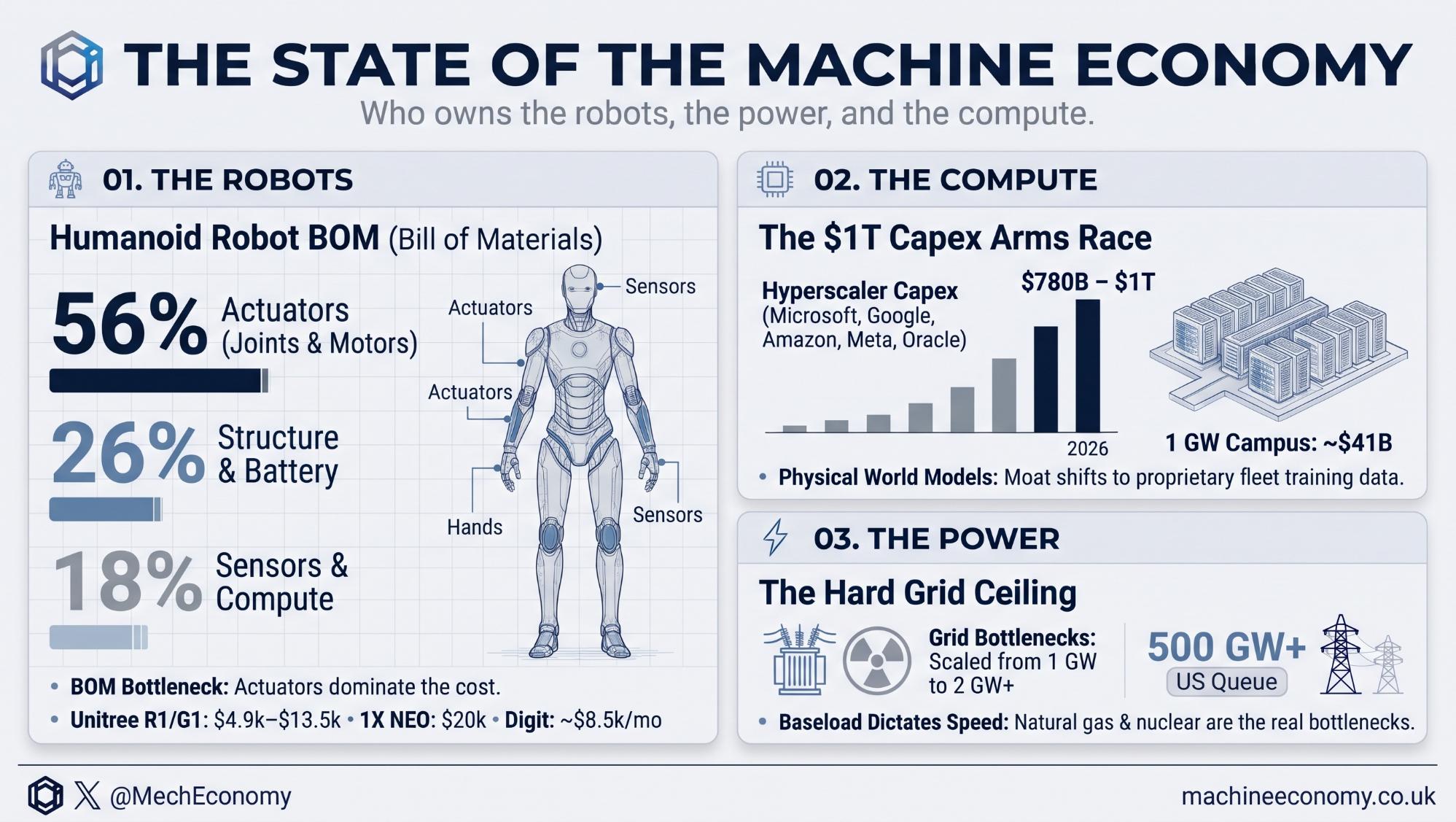
On the split used here, actuators are 56 percent of a humanoid: the joints, the motors and the gearboxes. A precise joint still wants a harmonic drive, a strain gauge and a brushless motor, and those do not get cheap because a demo looked good. Structure and battery are 26 percent: the frame, the casings, and a pack dense enough to move a machine of about 150 pounds for a few hours. Sensors and the onboard computer are 18 percent: cameras, lidar, force sensors, and the chip that runs the vision-language-action model at the edge.
Western firms still lead on the world models. The metal is a different contest. Tier-1 car and industrial suppliers, Tuopu, Sanhua and Joyson among them, are running actuator volume down existing automotive lines. The filed example of that layer is Schaeffler’s plant in Taicang, where the work is the joint itself.
What an hour costs
The price bands in this model are three. Research and entry machines, such as Unitree’s R1 and G1, sit between $4,900 and $13,500: cheap enough for a lab, and too lightly built for heavy labour. A consumer or small-business pre-order, 1X’s NEO among them, is about $20,000, or a monthly subscription. An industrial machine is a lease. Agility’s Digit is carried here at about $8,500 a month.
That monthly price is a tight equation. One eight-hour shift is about $51 an hour, well above the warehouse wage the robot is supposed to stand next to. Two shifts, sixteen hours, brings it to about $25.50, close to even. The figure that changes the case is three shifts, on the order of 6,000 hours a year, which takes the same lease to about $17 an hour. Utilization, not the sticker, is the return. A robot that waits for a charger, or for a person to reset it, does not get there. Digit 5’s promised fast charge is an attempt at that problem, and the first of those machines are not due until 2027.
The compute
The models behind the machines are being bought at a scale that no longer looks like ordinary corporate spending. Combined 2026 capital expenditure at Microsoft, Google, Amazon, Meta and Oracle is tracking, on the range used here, between $780 billion and $1 trillion, with close to $970 billion already committed in long leases and future buildings. One way to see a single campus: a 1-gigawatt frontier site, built, equipped and kept in current silicon, is on the order of $41 billion.
The spending is not only for a better video of the world. A model trained on pictures can look fluent and still put a foot through wet snow, because a frame does not contain the friction. The gap is closed with physical data a company records itself. Tesla’s production-standard Optimus line at Fremont is the public version of that bet: a fleet that meets the real floor, and in doing so produces the tactile record the next model is trained on. The firm with the largest fleet of machines that actually work will own the data the others cannot scrape.
The power
None of the above runs without electrons, and the scarce thing is no longer only the chip. Frontier campuses are moving from 1 gigawatt toward 2 and past it. At that size a data centre is an industrial load. More than 500 gigawatts of projects are sitting in United States interconnection queues. Substation transformers are quoted on backlogs of three to four years. The grid, not the model, is the ceiling.
Buyers are stepping around the queue. The deals now being signed are behind the meter: output from existing nuclear plants, gas turbines on the site, and private microgrids, so a training run does not wait on a regional upgrade. Nuclear baseload, gas, and small reactors have become part of the AI plan because the alternative is a building that cannot be switched on.
The rails between the machines
A fleet that charges, shares sensor data and buys computation cannot clear those payments through a bank that takes days. The pieces already being built are smaller and more specific. One is a machine paying another, in real time, for a charge, a location fix, or a burst of compute. The other is decentralized physical infrastructure: wireless, storage or computing that many operators run, and that a nearby robot can buy if the work can be checked. peaq’s building interface is one filed case of a machine using a network that was not built for it.
What decides it
The machine economy is not a future product cycle. It is a physical build, already priced in capital expenditure, in actuator contracts, and in power that has not been connected. The advantage will not sit only with the best model. It will sit with whoever can buy the joints, keep the machines on a third shift, and turn the lights on.