Robotics · 2 November 2026 · 4 min read
Rhoda’s robot put a part back and tried again. That was a visit, not a shift
Humanoids Daily wrote on 1 November that Mike Schroepfer watched Jagdeep Singh’s machines unpack automotive parts and recover when a grasp went wrong. Singh put a new task at 10 to 20 hours of teleoperation, after video pre-training, with the model running in the cloud. Paid factory work is a target for the end of the year. The visit did not show a week of it.
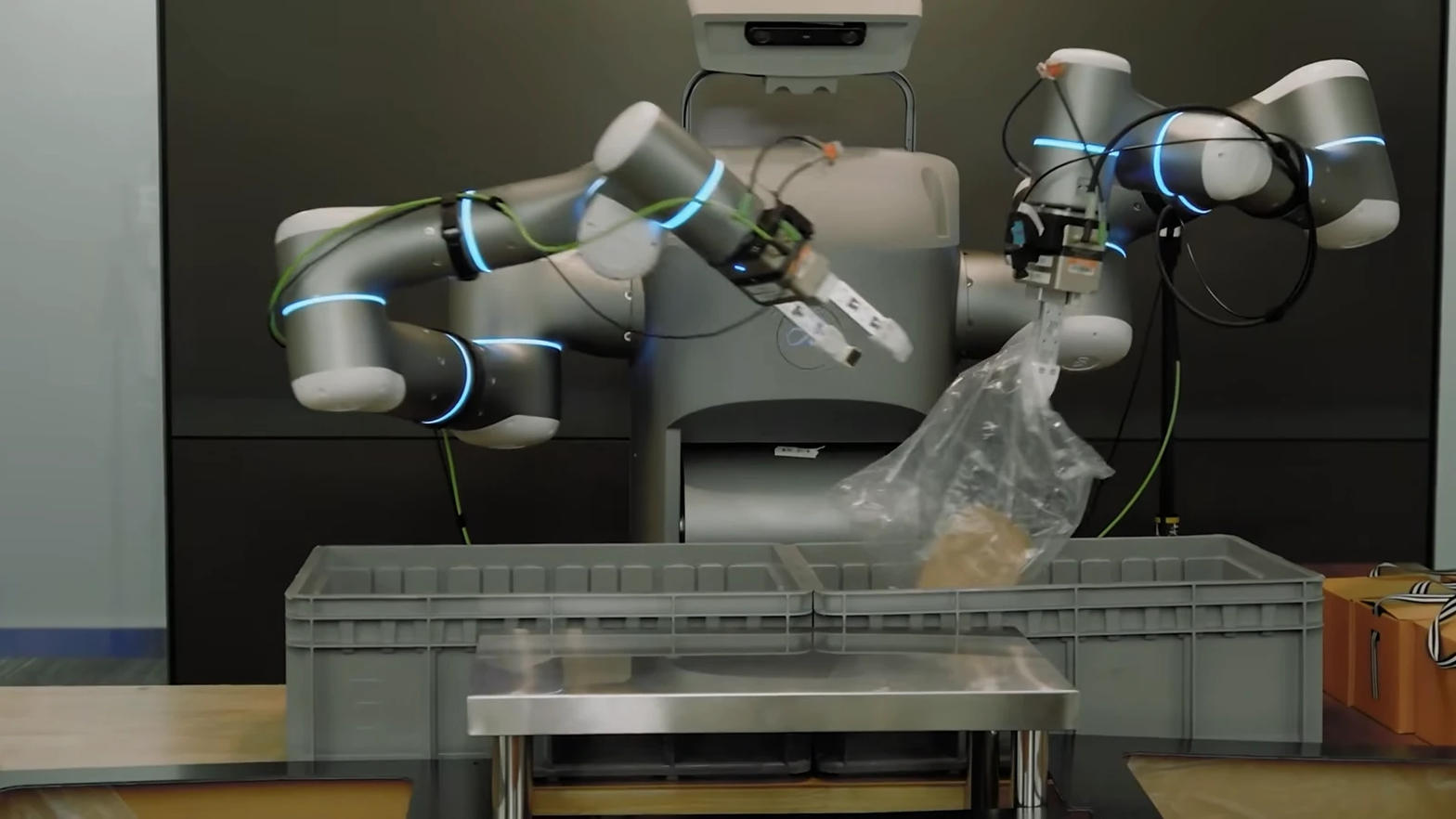
The account is a visit, written up on 1 November, not a customer’s log. Humanoids Daily says Mike Schroepfer, the former chief technology officer of Meta, joined Jagdeep Singh, Rhoda AI’s founder, to watch robots unpack automotive parts, handle inspection equipment, and recover from disturbances introduced during the demonstration. The recoveries it describes are specific and small: an accidental grasp, extra waste that had to be taken out, and paper trapped inside a plastic bag. The longest sequence is a 10 kilogram box of ball bearings. The robot is said to open the packaging, pull paper from a plastic liner, empty the bearings into a metal tote and separate the waste. A recovery that a visitor watched is evidence the arm can change its mind once. It is not a rate.
The training claim is Singh’s, as that write-up records it. Tasks can be learned with 10 to 20 hours of teleoperation data, after extensive video pre-training. The same account says he put model inference in the cloud, with low-level control left on the robot. That split matters more than the party trick. If the decision is computed somewhere else, the arm in the room is not the whole machine. The visit does not say what the arm does when that link drops, or how long a prediction takes. Ten to twenty hours is a claim about how a task is taught. It is not a count of hours the robot has worked without a person in the room.
The commercial sentence is still in the future. Rhoda is targeting wheeled industrial robots and paid production deployments before the end of 2026, with a remote Robot Operations Center in the plan. Humanoids Daily’s own line is the right width: that is a rollout target, not evidence that the demonstration is already a production performance, and the visit does not establish sustained factory reliability. A remote operations centre is a room full of people who can still step in. It is not the same fact as an arm that finished a shift alone.
A different robotics lab opened a beta of a hosted robot model in October. That was a waitlist. This is a visit. Neither has published a week of unattended work, a reject rate, or a customer saying the robot finished a counted job. What Rhoda has now put on camera, if the write-up is fair to the tape, is an arm that noticed a bad grasp and undid it. That is a more useful demo than a perfect one. It is still a demo.