AI · 27 October 2026 · 4 min read
GPT-6.1 Terra is the cheaper model for a day at the screen. The scores are OpenAI’s
OpenAI released it on 26 October at $1 per million input tokens and $5 per million output, half the standard price of GPT-6.1 Sol. It is in ChatGPT Work and Codex, and in the API as gpt-6.1-terra. It is not in ordinary Chat. The claim that it matches Astra at a tenth of the token price is the company’s own test.
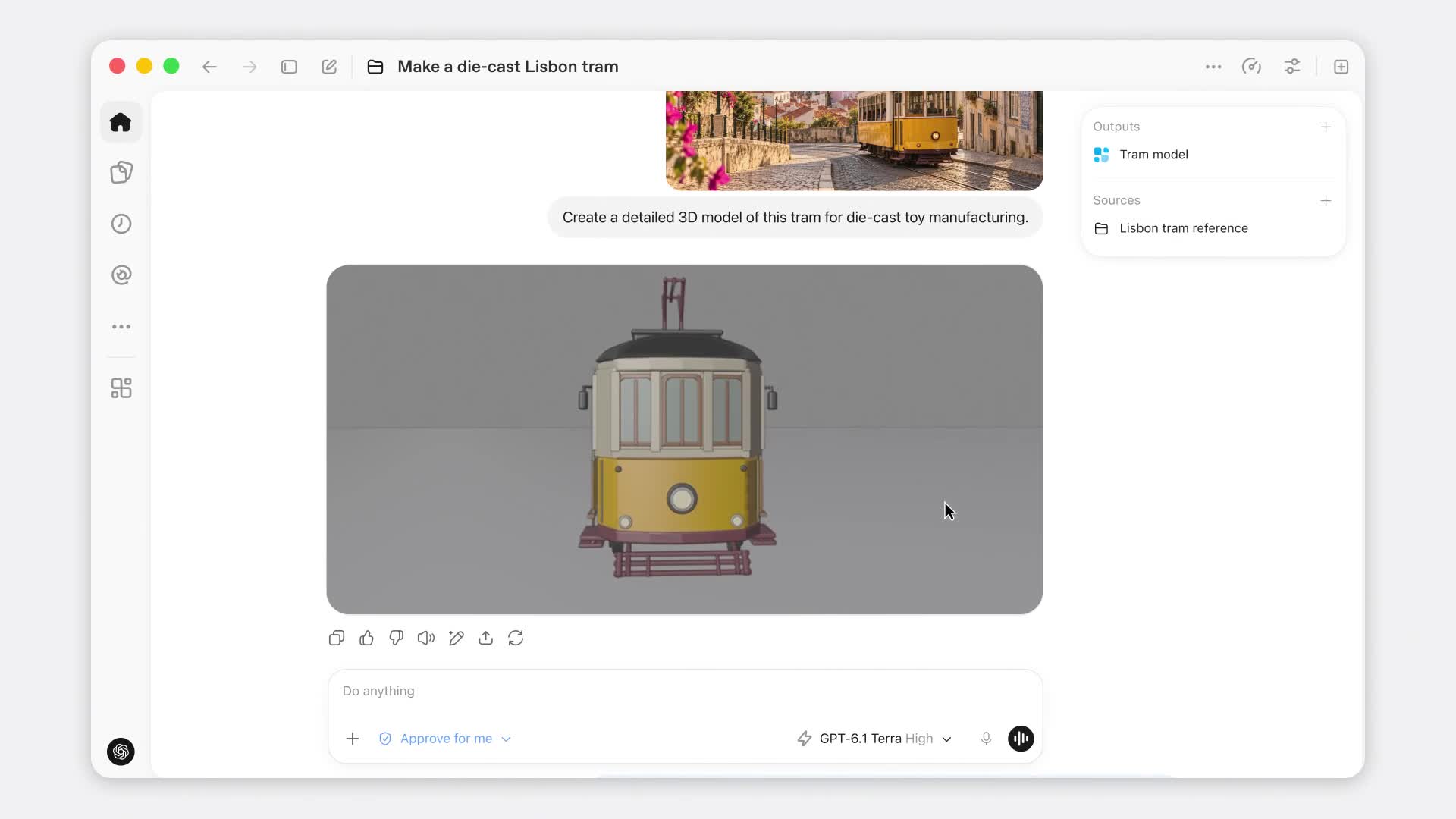
OpenAI released GPT-6.1 Terra on 26 October. The price is the part a buyer can check without a benchmark. Standard API rates are $1 per million input tokens, $0.05 per million for a cached input, and $5 per million output tokens. OpenAI says that is half the standard price of GPT-6.1 Sol, the model one step up, and about a tenth of the token price of GPT-6 Astra. The API name is gpt-6.1-terra. A lower rate does not say how many tokens a real afternoon uses, or how often a person has to undo what the model did.
The job it is being sold for is the screen, not the hardest piece of code. OpenAI describes it as a fast model for visual reasoning and computer use: reading what is on a display, moving between applications, drafting, filling a form, working from a technical drawing. For deep research or complex coding it points people to Sol or to Astra. Astra is the model already in a private preview on Google Cloud. Terra is the one meant to be left on for ordinary professional work, because the bill for a whole day was the objection to the larger models.
The performance numbers are OpenAI’s measurements, on tests it chose. On Agents’ Last Exam, a set of professional computer-use tasks, it says Terra at medium effort scores 15 points above the previous Terra, GPT-5.6, at about a third of the cost, and matches Astra. At maximum effort it says Terra uses fewer than a third of the tokens of Claude Opus 5.5, at a quarter of the price per token, which it turns into a cost per task about nine times lower. It also says Terra finishes tasks more than three times faster than Astra and Sol. An outside index, if one is published, can disagree with every one of those ratios. Until then they are a vendor’s chart.
Where it actually sits is narrower than the last card of the launch video, which says it is available on all paid plans. The release notes say Plus, Pro, Business, Enterprise and Edu, inside ChatGPT Work and Codex, not in ordinary Chat, and only as the rollout reaches an account, a region and a workspace. Plan limits do not go up. The system-card addendum treats the model as Critical for cybersecurity, the top tier of OpenAI’s preparedness scale, and High for biological and chemical capability, and says it keeps the safeguards used for Astra and Sol. A cheaper model that can operate a computer is a different product from a demo of a tram. The price is public. The error rate on a stranger’s files is not.