Infrastructure · 2 November 2026 · 5 min read
Envision says 800-volt power is on at its AI campus. Three gigawatts is still the plan
The 2 November release says a solid-state transformer, batteries and a controller are powering live workloads at Galaxy in Ulanqab, and calls that the first commercial deployment of its kind. It gives no wattage for the system that is on. The campus opened in August. Three gigawatts, a million accelerators and mostly renewable power are what the company says it has planned at full build-out.
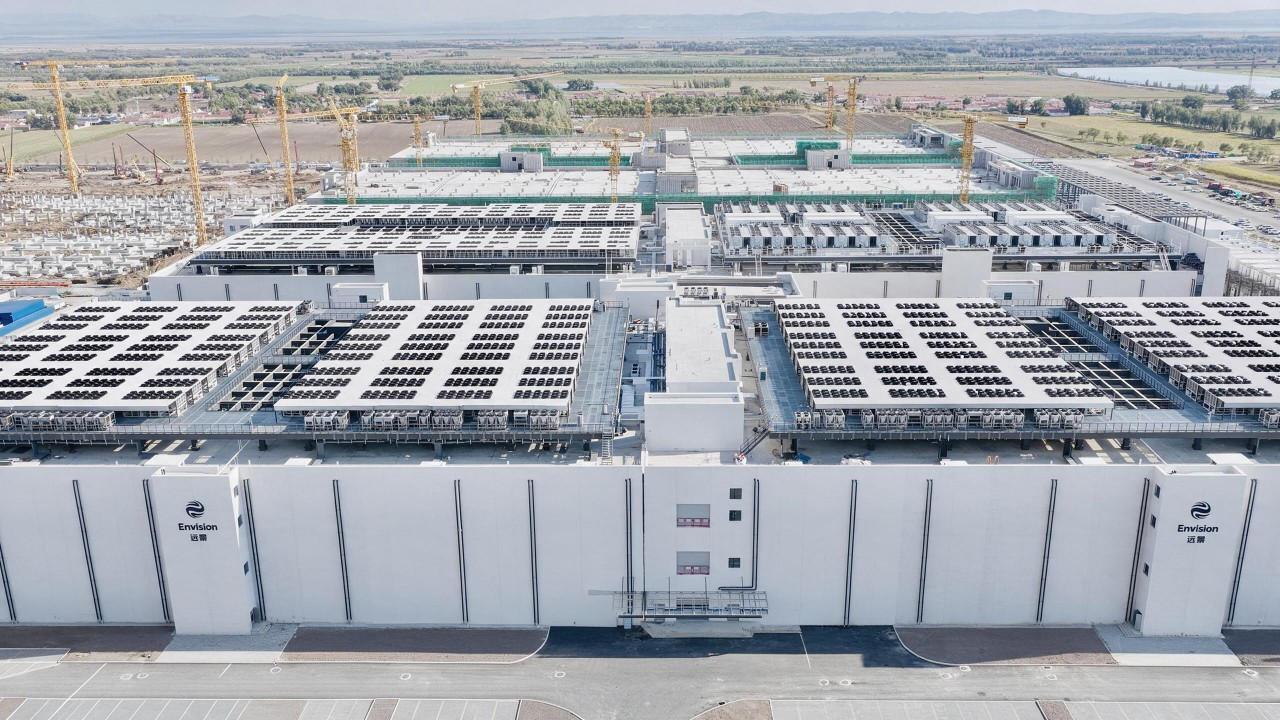
Envision said on 2 November that an integrated 800-volt direct-current power system is now powering live computing workloads at its Galaxy AI data-centre campus in Ulanqab, in Inner Mongolia. The release calls this “the world’s first commercial deployment” of that kind of system in a large-scale AI data centre, delivering power “end to end from grid input to computing loads.” World’s first is the company’s claim. A live workload is also the company’s claim. The release does not say how many racks are on the new bus, for how many hours, or at what power. No kilowatt for the installation is in the document.
What the release does specify is the shape of the system, not its size. It combines solid-state transformers, battery storage, and equipment that adjusts direct-current voltage for the computing hardware. A Dubhe Controller, which the company says is supported by its Dubhe Energy Foundation Model, coordinates the transformers and the batteries. Three capabilities are listed: stable conversion from 10 kilovolts of medium-voltage alternating current to an 800-volt direct-current bus; batteries that provide both second-scale power support and minute-scale backup; and millisecond coordination between the transformer and the storage, so a swing in graphics-processor load is absorbed on site. Kevin Huang, senior vice president of Envision Energy, said the system “is now powering live computing workloads” and called that a step from a vision to “an operational reality.” A controller that is said to match supply to demand is not a meter reading.
The campus and the power system are not the same number. Galaxy began operations in August 2026. The planned capacity is 3 gigawatts. The campus is “designed to support” up to one million AI accelerators “at full build-out,” and more than 80 percent of its power is “planned to come from direct renewable electricity connections.” Planned, designed and full build-out are future tense. They are not a statement of what is connected today. The photograph issued with the announcement still shows cranes over the site. A hall can be taking power while the rest of a campus is a building site. Three gigawatts is the plan for the finished place. It is not the rating of the transformer the release has declined to size.
A further aim sits one step further out. Envision says it wants to scale the approach through Mission Gobi, which “targets” 5 gigawatts of green AI data-centre capacity in desert regions by 2030. A target for the end of the decade is not this week’s bus. The useful comparison is with other power stories that also stop short of a switched-on megawatt. Gas generators ordered for a data centre can be a loan against equipment that has not been tied to a site. A chip that answered from orbit was one prompt, not a plant. This release is a third kind of fact: a company saying a new electrical architecture is already feeding computers, at a campus whose finished size is still a plan, and without publishing the watts of the machine that is said to be on.