AI · 21 November 2026 · 8 min read
Anthropic’s $119.5B IPO, NVIDIA’s 40% Drawdown, and 2,900 MW of Off-Grid Gas: The Week AI Markets Repriced Infrastructure
Record revenue at NVIDIA and the largest public listing in history at Anthropic collided with an SEC accounting inquiry, immediate US cloud-compute export controls, and a nationwide clash over data center power.
Lede & Nut Graf
Between November 16 and November 21, 2026, the artificial intelligence (AI) industry posted its two largest commercial milestones to date—and suffered its sharpest public-market repricing of the cycle. Anthropic closed a record $93.5 billion initial public offering (IPO) on Nasdaq alongside a $26 billion supplier private placement (Anthropic press release, Nov. 20, 2026), while NVIDIA doubled quarterly sales to $115.8 billion on the rapid ramp of its Vera Rubin platform (NVIDIA Investor Relations, Nov. 18, 2026).
Yet equity investors sold both prints. By Friday’s close, NVIDIA had fallen more than 40% from its October peak amid a reported Securities and Exchange Commission (SEC) accounting review, Anthropic had tested within five cents of its $83 offer price, Washington had enacted immediate remote-access chip export controls, and US grid operators had finalized sweeping federal tariffs to ring-fence data center power costs. Together, the week’s events mark a structural pivot: public markets and regulators are no longer underwriting frontier AI on top-line token velocity alone.
Technical & Financial Breakdown
1. Frontier AI Hits Public-Market Gravity
Anthropic priced 980 million Class A shares at $83.00 on November 18—above its $70–$78 range—and closed the offering on November 20 with underwriters exercising the full 147-million-share overallotment option (SEC Form S-1/A; Anthropic, Nov. 20, 2026). Combined with a $26 billion non-voting private placement bought by Google, NVIDIA, Microsoft, AMD, Broadcom, Micron, and Taiwan Semiconductor Manufacturing Co. (TSMC), Anthropic raised $119.5 billion in gross proceeds.
On the income statement, Anthropic’s S-1 revealed an $81 billion annualized revenue run rate as of October 31 and serving compute costs down to roughly 14 cents per revenue dollar (~85% serving gross margin, versus 71 cents a year earlier) (Investing.com, Nov. 21, 2026). However, after opening Thursday at $111.50, shares of ANT faded to close Friday at $88.91 after touching $83.05 intraday. Secondary buyers zeroed in on the liability side: $232.4 billion in post-IPO cash and investments stacked against $901 billion in total committed spending, including $451 billion in signed, uncommenced compute leases.
Elsewhere in model economics, Google DeepMind launched Gemini 4 Neon on November 18 at $3.00 per million input tokens and $15.00 per million output tokens with a unified 1-million-token context window, targeting a 32% per-task cost reduction versus Gemini 4 Carbon at default high reasoning (Google Blog, Nov. 18, 2026). Meanwhile, vertical agent startup Model ML raised a $250 million Series B at a $1.5 billion valuation by shifting financial workflows onto fine-tuned open-source models at a claimed 2% of frontier API cost (FinTech Global, Nov. 20, 2026).
2. Silicon Strength Collides With Regulatory and Credit Friction
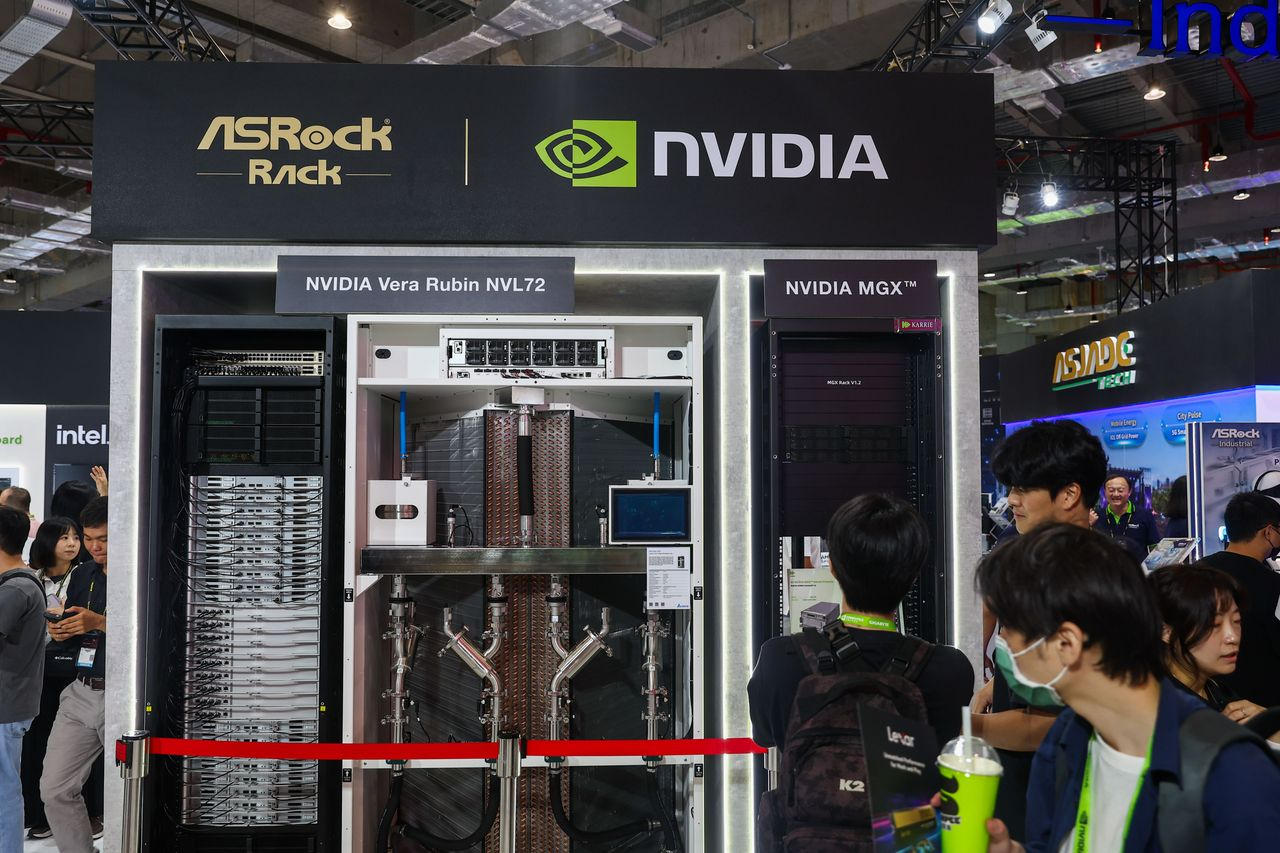
NVIDIA’s Q3 FY27 earnings on November 17–18 proved physical demand remains intact: revenue climbed 103% year over year to $115.8 billion, Data Center sales hit $107.6 billion (+110%), and non-hyperscale AI cloud and enterprise sales jumped 195% to $47.5 billion (NVIDIA Q3 FY27 Presentation, Nov. 17, 2026). The liquid-cooled Vera Rubin NVL72 rack added nearly $20 billion sequentially—NVIDIA’s fastest architecture ramp—and delivered up to 2x performance per graphics processing unit (GPU) over Blackwell Ultra in MLPerf Training.
Two headwinds overwhelmed the beat. First, management guided Q4 FY27 non-GAAP gross margins down from 74.9% to 71.0%–72.0% on rack-scale ramp costs, even with revenue guided to $130.0 billion (±3%). Second, shares slumped 7.2% Friday to $135.41—more than 40% off their October 6 peak—after Reuters reported SEC enforcement staff are reviewing potential accounting issues at NVIDIA (Unite.AI/Reuters, Nov. 20, 2026; FinanceFeeds, Nov. 21, 2026).
Export controls tightened simultaneously. On November 19, the Commerce Department’s Bureau of Industry and Security (BIS) enacted an immediately effective Interim Final Rule (91 FR 74970, 15 C.F.R. § 744.24) requiring licenses for advanced AI chips shipping to Singapore, Malaysia, Indonesia, Thailand, and Brazil, as well as any offshore or digitally linked data centers providing more than 12,000,000 aggregate Total Processing Performance (TPP) to Target Country Companies—with a strict 90-day window to obtain licenses (Federal Register, Nov. 19, 2026). That same day, AMD lost roughly $67 billion in market value (-7.72% to $489.19) as the Singapore licensing overhang collided with a Hunterbrook short report alleging AMD firmware appeared in updates from Entity-Listed Chinese server maker IEIT Systems (TradingKey, Nov. 20, 2026). At the foundry layer, TSMC reportedly began auditing customer balance sheets and demanding upfront cash from smaller AI chipmakers, while SK Hynix converted ¥129 billion ($810.3 million) in bonds to become Kioxia’s largest shareholder at 14.1% (TechPowerUp, Nov. 19, 2026; SEC Form 6-K, Nov. 20, 2026).
3. Physical AI Shifts to Wheels, Factory Mandates, and Real-World Data
Capital and engineering pragmatism accelerated across robotics. Genesis AI closed a $500 million Series A at a $3.5 billion valuation for Eno, a wheeled dual-arm robot trained via tactile force-feedback gloves that ditches bipedal legs for factory stability (Genesis AI, Nov. 17, 2026). General Motors Co. outlined plans to expand North American factory robotics by roughly 20% by 2028—building proprietary systems in Indiana while grading parts suppliers on automation scorecards (International Finance, Nov. 19, 2026).
Data infrastructure split along two tracks: NVIDIA released five two-prompt Cosmos Data Factory synthetic video blueprints claiming a 45x compute-cost reduction versus $125/clip road testing (NVIDIA Technical Blog, Nov. 18, 2026), while Accel-backed Humyn Labs raised $47 million after crossing $50 million in annualized revenue in six months capturing real-world vision, audio, touch, and motion data for US robotics labs (TechCrunch, Nov. 18, 2026).
4. The US Power Grid Draws a Hard Line—Pushing AI Off-Grid
All six US regional transmission organizations (RTOs) concluded their Federal Energy Regulatory Commission (FERC) large-load show-cause filings this week. PJM Interconnection proposed "Fast Energization" to halve interconnection studies from roughly two years to one year, alongside mandatory voltage and frequency ride-through rules (ER27-522-000) for Large Computational Loads (50 megawatts (MW) or more, with at least 25 MW behind power electronic converters) following July’s 3.9-gigawatt (GW) Northern Virginia disconnect (PJM Inside Lines; CASRAI, Nov. 16, 2026). Existing PJM campuses receive one year to achieve compliance, while utilities across PJM, MISO, New York, and California sought 10-to-20-year transmission contracts with 80%–85% minimum demand floors.
Ratepayer pushback hit a boiling point: consumer advocates from seven states joined PJM’s Independent Market Monitor on November 19 in demanding PJM delay its December capacity auction—citing $29.4 billion in irreversible data center capacity cost hikes—with a board response requested by Monday, November 23 (Utility Dive, Nov. 19, 2026).
Faced with grid congestion and tariff lock-ins, developers moved aggressively behind the meter. On November 19, the Ohio Power Siting Board approved two private, off-grid natural gas power plants totaling 2,150 MW—the 1,350 MW Fairfield Energy Center for Vantage Data Centers and the 800 MW Ashville Energy Center—despite Ohio voters passing 18 local data center bans this year (Signal Ohio, Nov. 19, 2026). In Texas, the Texas Commission on Environmental Quality (TCEQ) lifted its permit freeze and cleared SpaceX for a 750 MW off-grid gas plant (35 turbines) in the Rio Grande Valley, while FERC approved 1.48 million dekatherms per day (Dth/day) of new interstate gas pipeline capacity across Virginia, West Virginia, New Mexico, and Texas (Reuters, Nov. 18, 2026; FERC, Nov. 19, 2026).
Second-Order Implications
This week’s convergence of financial, regulatory, and physical constraints is rapidly separating Tier 1 balance sheets from leveraged challengers. If TSMC enforces upfront cash terms on smaller AI silicon startups while BIS forces Southeast Asian neoclouds into a 90-day licensing race, capital will consolidate even more tightly around US hyperscalers and self-funding cloud buyers.
In US energy infrastructure, the simultaneous approval of 2,900 MW of captive gas generation in Ohio and Texas—alongside PJM’s minimum-demand tariff fight—confirms that behind-the-meter natural gas is no longer a stopgap. For 2027–2029 AI cluster deployments, private thermal generation and interstate pipeline access have become the primary schedule-critical assets.
Caveats & Open Questions
Several of the week’s sharpest market catalysts remain unresolved. Neither the SEC nor Reuters has identified which specific accounting practices are under review at NVIDIA, and an enforcement examination is not a finding of wrongdoing. Similarly, BIS has not clarified how offshore clusters will be treated if license applications remain pending past its 90-day deadline, and PJM’s board has yet to rule on Monday’s November 23 deadline to postpone its December capacity auction. How markets digest ANT’s potential options-trading debut on November 23 alongside PJM’s decision will set the tone for the rest of Q4.
More in AI