Robotics · 6 November 2026 · 5 min read
Serve had 917 robots out delivering. The loss was still $59 million
Serve said on 5 November that third-quarter revenue was $2.8 million, up 313 per cent on a year earlier and below the previous quarter. Daily active robots, its average of machines making deliveries, were 917. The net loss was $59.2 million. The full-year revenue guide is now $12 million.
Serve Robotics reported on 5 November, for the quarter ended 30 September. Revenue was $2.8 million, up 313 per cent on a year earlier. The accounts put the revenue line at $2.835 million, against $3.238 million in the second quarter and $687,000 a year earlier. The year-on-year rise is from a small base. The quarter itself was smaller than the one before it. Fleet services were $2.582 million, against $2.305 million. Software services were $253,000, against $933,000.
The cost of that revenue was $10.4 million. The gross loss was $7.6 million. Serve says gross margin improved from the previous quarter, and that recurring revenue was 69 per cent of the total, “nearly 70 per cent.” A mix is not a margin. Recurring revenue can still be sold at a loss. Branding revenue, the company says, grew nearly 80 per cent from the previous quarter. That line is not broken out in the revenue table. Management also said fleet margin improved by more than 100 percentage points from the previous quarter, while operating expenses were driven down. Operating expenses were $53.6 million, against $57.3 million the quarter before and $30.4 million a year earlier. Down means the previous quarter, not last year. The release does not say what the fleet margin was, before or after. The operating loss was $61.2 million. The net loss was $59.2 million, $0.68 a share, against a net loss of $64.1 million in the second quarter.
How many robots were actually out
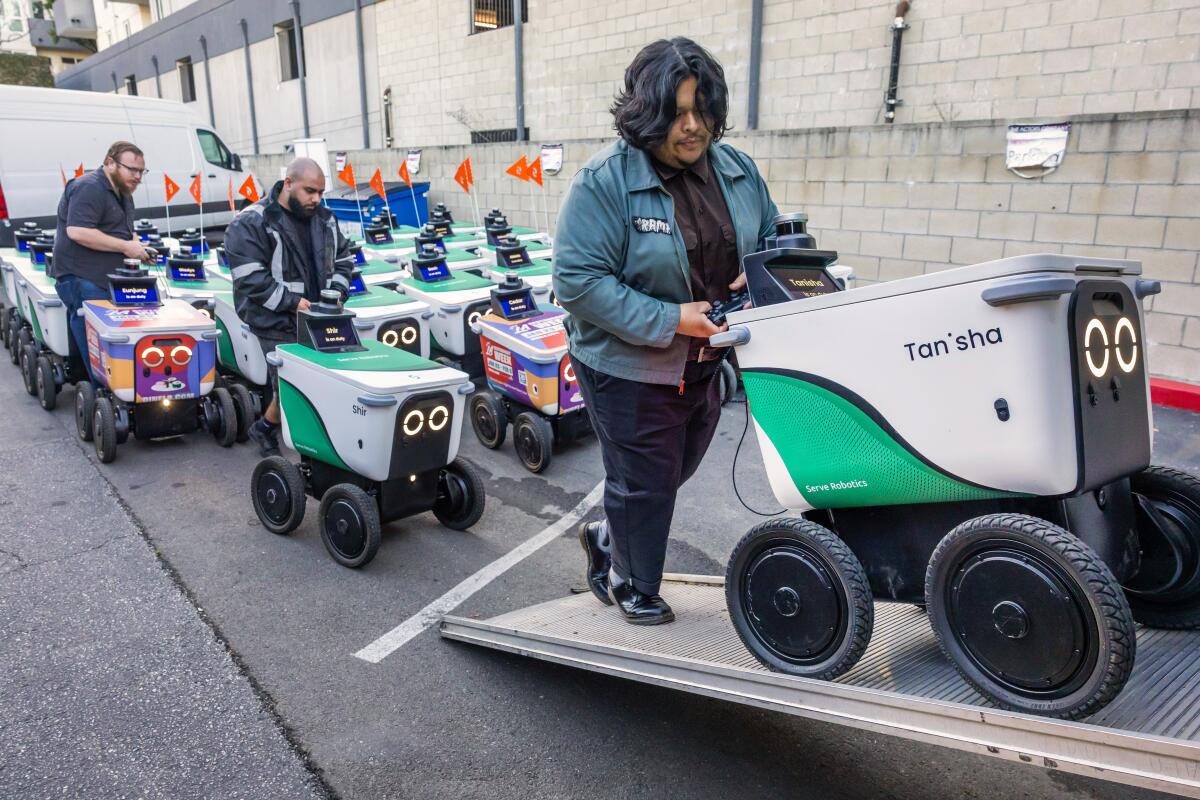
Serve defines a daily active robot as the average number of robots performing deliveries in the period. That average was 917, against 792 in the second quarter and 312 a year earlier. The figure includes the outdoor fleet and the indoor fleet. In 2026 Serve bought Diligent Robotics, which makes service robots for hospitals, so an indoor machine counts in the 917. The company says it has deployed more than 2,000 robots across the United States. An average of 917 on delivery is not 2,000 at work. Among new delivery-platform partners, it says, daily delivery volume tripled and the number of merchants grew 2.5 times. That sentence is about the new partners, not about every robot. In October, after the quarter had closed, it exclusively launched a first city in Australia. The release does not name the city.
Hospitals, cash, and a guide that is still small
On hospitals, the release says Serve entered 12 multi-year contract extensions and added four new hospitals in the year to date through the third quarter. It does not give the revenue, the length, or the number of robots in those contracts. It calls the healthcare revenue strong, and consistent with expectations. Strong is not a number. Liquidity at 30 September was $198.0 million. Of that, cash was $50.8 million and short-term marketable securities were $147.2 million. The balance sheet also shows $26.3 million of long-term marketable securities, which is not inside the $198.0 million liquidity line. Nine-month revenue was $9.057 million. The nine-month net loss was $172.4 million. Cash used in operations over those nine months was $123.5 million.
The full-year revenue guide is now $12 million, up from a range of $9 million to $10 million. Nine months are already in at $9.057 million, so the new guide needs about $2.9 million in the fourth quarter. That arithmetic is ours. The full-year non-GAAP operating-expense guide was cut to $150 million, from $160 million to $170 million. The same outlook puts GAAP operating expense at $208 million, with $50 million of stock-based pay and $8 million of amortisation in the bridge. A guide is not cash already spent. About 88 million shares were outstanding at 30 September. The same afternoon the company opened its fleet tools to other firms, and that release names no price.