Infrastructure · 8 November 2026 · 4 min read
A Vancouver yard will roll steel for ocean computers. None of them is at sea
OPB reported that Panthalassa cut a ribbon on 6 November at a former Kaiser shipyard in Vancouver, Washington, to build floating nodes meant to power AI computers from waves. About 50 people would work there when it is fully staffed. The paper does not say a node is generating power, or running a model, today.
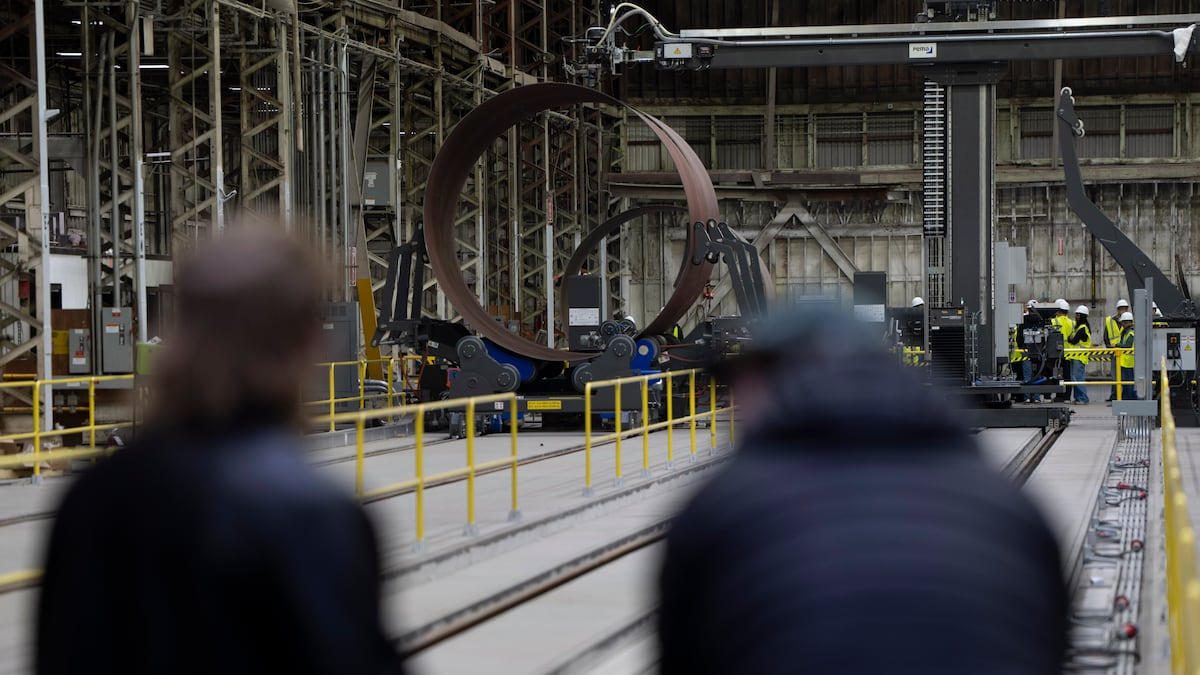
Oregon Public Broadcasting was at the ribbon on 6 November, in Vancouver, Washington, in a warehouse that was part of the Kaiser shipyard on the Columbia River. Panthalassa, based in Portland, says the building is where it will stop making nodes one at a time and start an assembly line. About 50 people would work there when it is fully staffed, rolling plate steel and using robotic welding. Finished nodes could go down the river. A line in a shed is not a machine offshore.
The node, as the company describes it, is an unanchored buoy that uses the power it makes, rather than sending it back to a grid. OPB says a full assembly can be six storeys high, most of it underwater, and that each node sits on a hollow tube which lifts seawater into turbines, the way a dam does. The chief executive, Garth Sheldon-Coulson, said the result “will be the cheapest green electrons on the planet.” That is his claim. The paper says tests of prototypes have been successful, which is also the company’s account. It does not say a node is generating power today, or that a server on one of them is answering a query. Dana Hartsig, the vice president of manufacturing, called the factory the first step towards a fleet. A step is not the fleet.
The money is raised. The ocean is not booked
OPB says the company raised more than $300 million this year, and that Peter Thiel helped recruit other investors for $140 million in the spring. It also says the company sought another $225 million from venture firms over the summer. Sought is not received. A figure of close to $2 billion, OPB says, comes from industry press, not from a filing. The same piece notes that ocean energy has been talked about for years and has not produced profits at a large scale, and that at least a dozen other businesses are trying the same bet.