Robotics · 9 November 2026 · 4 min read
Nvidia’s new robot model finished 40 of 50 tasks once. The 95 percent is five demonstrations
On 9 November Nvidia introduced GR00T 2, which it calls an open world-action model, trained in part on 100,000 hours of its own human video. On the company’s tests it managed 40 of 50 tasks at least once with no task demonstration, 71 percent after one demonstration and 95 percent after five. The blog does not say how the 50 were chosen.
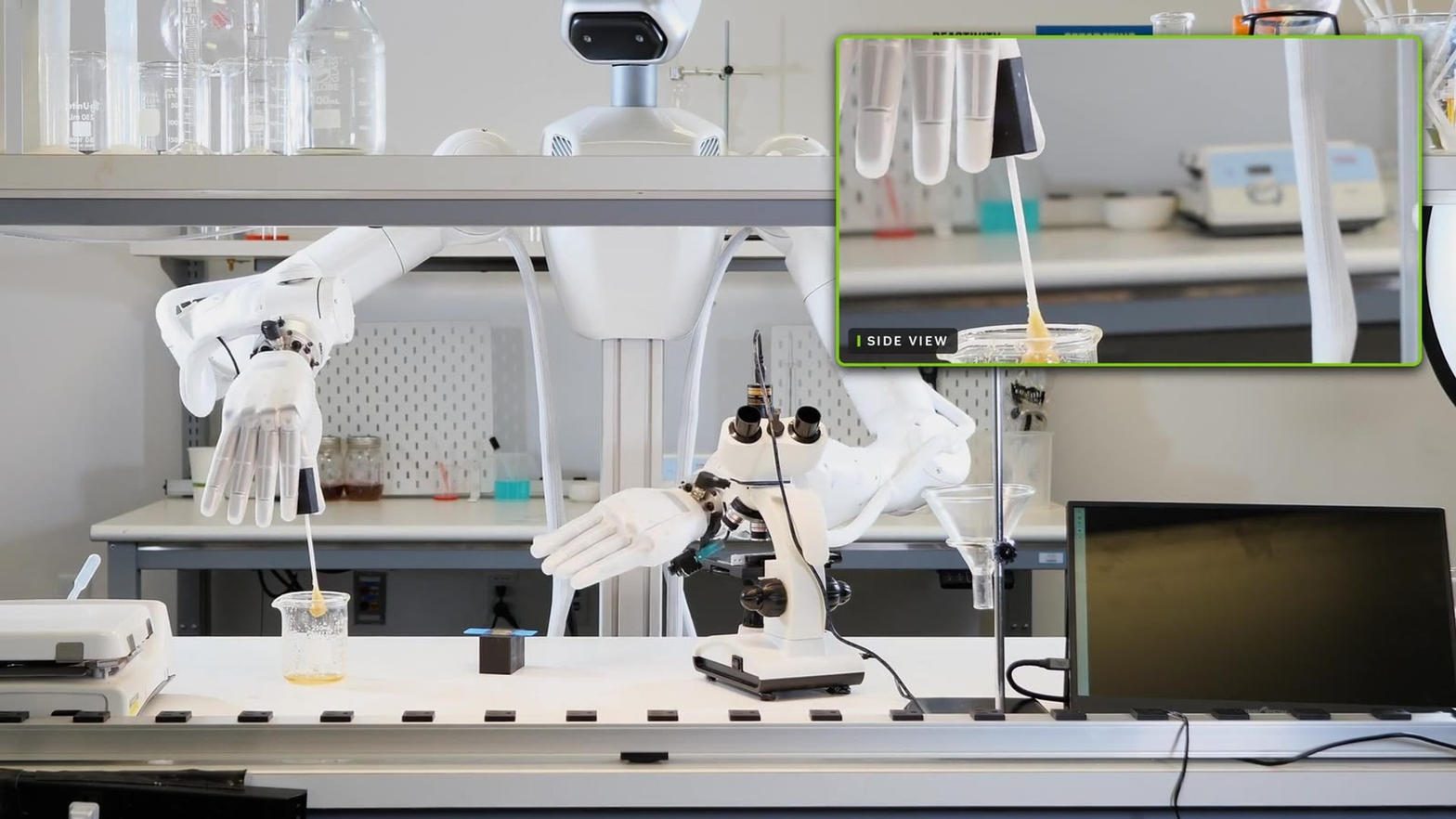
Nvidia published on 9 November, for the Conference on Robot Learning in Austin, a model it calls GR00T 2. It describes it as an open frontier world-action model, built on Cosmos, and trained on robot data and human data, including 100,000 hours of Nvidia’s own open first-person video. Open, in the blog, is the company’s word. The post does not say when the weights or the code can be downloaded.
The scores are Nvidia’s tests. The blog says the model completed 40 of 50 evaluated tasks at least once without a demonstration of that task. With one demonstration per task, average success across the 50 was 71 percent. With five, it was 95 percent. The blog does not say how those 50 tasks were chosen, or how many tries sat behind “at least once.” A high average on a set the tester picked is still the tester’s average. Nvidia also says the model currently ranks among the top three in the vision-language-action and world-action categories of four named benchmarks. A rank on a leaderboard the company is quoting is not an independent rerun.
On factories, the verbs are not the same. Nvidia says Foxconn is applying GR00T 2 to automation for building servers, and that Siemens is evaluating it on industrial work. Applying and evaluating are the company’s words for other companies. Neither is a count of servers finished, or of hours a line has run. Alongside the model, Isaac Lab 3.0 can switch physics solvers, including Newton, which the blog says can now stand in for cables and cloth. On one vision benchmark, Nvidia says Lab 3.0 with Newton trained up to 2.5 times faster than Lab 2.3 with its older solver. Up to, on one benchmark, is not every job.