AI · 15 October 2026 · 6 min read
NEURA says its new robot model can feel and hear. The laundry job is still a demo
Neuron AI adds touch, sound, robot state and memory to 3D vision, and NEURA says it runs on the robot rather than in a cloud. The proof it has scheduled is an eleven-minute laundry sequence by the 4NE1 humanoid at GTC Berlin, 20 to 22 October. No success rate is published.
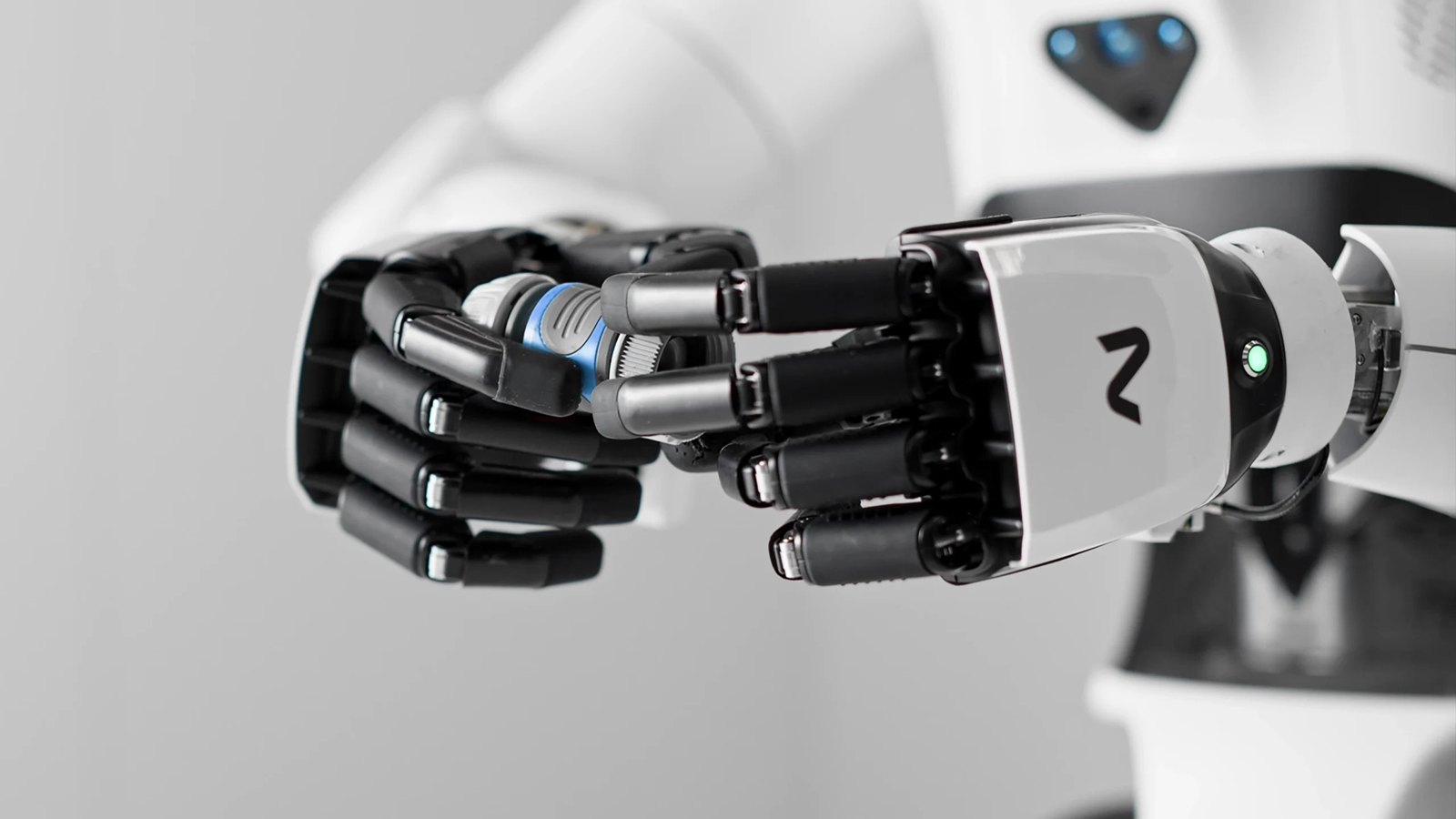
NEURA Robotics said on 14 October that it has a foundation model called Neuron AI. The company describes it as a perception-language-action model: 3D vision, touch and force, audio, the robot’s own joint state, and language, held with memory and turned into movement. The point it argues is that a camera goes blind the moment a gripper closes around an object. A person knows a screw has caught because of the feel, and knows a connector is seated because of the click. NEURA says the model is meant to give a robot those other channels, and to remember an object after it leaves the frame.
On its product page the company says Neuron AI is deployed on the robot, so the next action does not wait on a round trip to a server, and that the customer’s data stays under the customer’s control. It says the model runs across five of its own bodies: 4NE-1 in two generations, a wheeled 4NE-1, and two other two-armed platforms, with different grippers and hands. Partners, it says, can fine-tune a skill and send it out through a platform it calls Neuraverse. Training, it says, mixes real robot data, simulation, and human demonstration, including work with industrial partners such as Schaeffler and Bosch. The model was developed in Metzingen.
An eleven-minute demonstration is not a shift
The test NEURA has put on a calendar is specific. At Nvidia’s GTC in Berlin, 20 to 22 October, station Berlin, hall 3, its humanoid 4NE1 is to run an eleven-minute laundry sequence on the current model: sort, load a washer, close it, reopen it, unload, and move the load to a dryer, without a person stepping in. The company says the demonstration is about handling and keeping a task in order. It does not say the run has already succeeded, how many attempts it takes, or what happens if a sock is the wrong shape. “Without human intervention” is the plan for a booth. It is not a published miss rate.
A model that can use touch is a reasonable answer to a real limit of camera-only robot models. Saying so, and shipping a weight that a customer can fine-tune, are different from a robot that finishes laundry on its own in a building that is not a booth. Local inference matters only if the computer on the robot is the one that actually ran the job, and if a site can say what failed when the link was not the problem. Berlin will be the first public look. It will not, by itself, be a factory result.