Robotics · 17 October 2026 · 6 min read
Fifteen Leju humanoids are loading parts in Hangzhou. They are still slower than the person beside them
Zhaofeng and Leju say the robots have run for about two months at a plant in Xiaoshan, with a reported 98 per cent success rate. A loading cycle still takes more than twice as long as a skilled worker. The company’s chairman says that gap has to close before the line makes sense at scale.
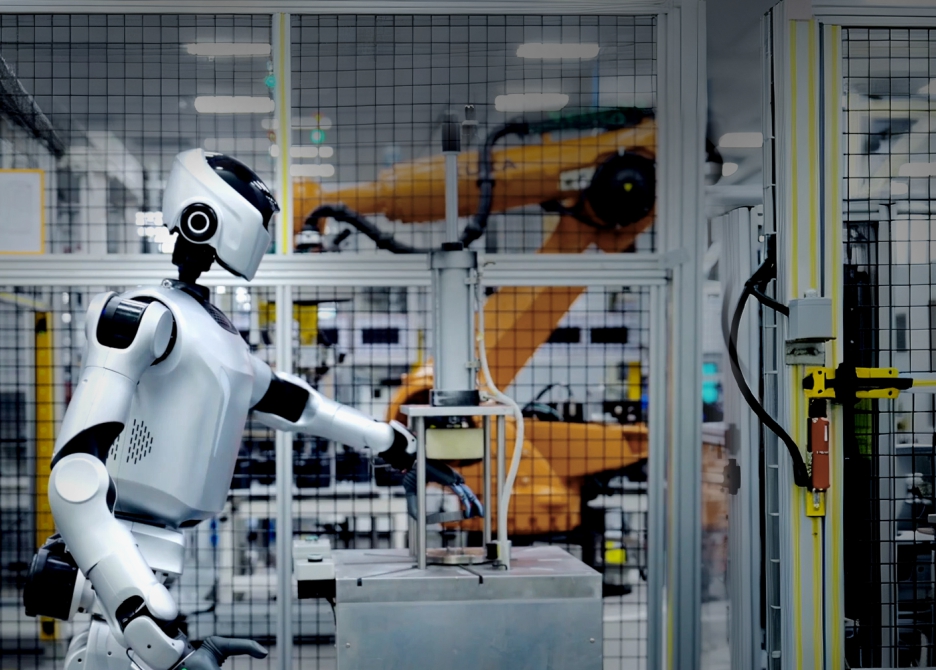
Leju Robotics and Zhaofeng, a listed maker of auto parts, presented 15 humanoid robots on a loading line at Zhaofeng’s No. 3 plant in Xiaoshan, Hangzhou, on 15 October. Securities Times, reported in English by Pandaily, says the robots pick small parts, including wheel-hub bearings with inner diameters of 80 to 120 millimetres, out of wire-mesh bins and set them on machining stations. A Zhaofeng representative told that paper the 15 machines cover 15 workstations and more than 10 kinds of part, and that the loading success rate is holding at 98 per cent. The same account says the deployment has already run for more than two months, about 1,000 hours, and has been part of producing more than 60,000 parts.
This is the Hangzhou parts plant that earlier photographs left unnamed. The papers now name the customer, the plant and the job. They do not name which generation of Leju’s KUAVO is on the line, what Zhaofeng pays, or whether a person still stands at the station. BT Finance, citing a site visit by 21st Century Business Herald, describes the cycle as standing ready, grasping an irregular part, carrying it and placing it, and says the robots were working without a remote control. Those are reported claims from the companies and from reporters in the building. They are not an independent audit of the 98 per cent.
The number that decides it is the seconds
Securities Times put a single loading cycle at under 40 seconds, against about 15 seconds for a skilled worker at the same station. Jiemian put the robot closer to 35 seconds. Zhaofeng’s chairman told reporters that the plant’s fixed robot arms already do some of these steps in 10 to 15 seconds, and that a humanoid would need to get to about 15 seconds before a wider rollout made sense. He expected that to take six months to a year. A machine that succeeds 98 times in 100 and takes twice as long has not replaced the worker. It has joined a line that already has a faster tool.
What is new, if the hours hold up, is that 15 bipeds have been left on a real parts job for two months rather than walked past a camera. Two months and 1,000 hours is a start of a record, not a finished one. The test that matters next is the one the chairman already set: a timed cycle near 15 seconds, on more than one part, without the success rate falling apart when the bin is messier than the demonstration. Until that number moves, the plant is evidence that a humanoid can feed a machine. It is not evidence that it should.