Robotics · 4 November 2026 · 4 min read
Korea opened a humanoid data factory. People are still driving the robots
KIMM said on 4 November that it has opened the country’s first data-production site for bipedal humanoids, with ETRI. Twelve robots are on the floor. Operators control them from a distance, and the movements are recorded for training. Outside users are not expected until the end of 2027. The release does not say the robots worked a shift on their own.
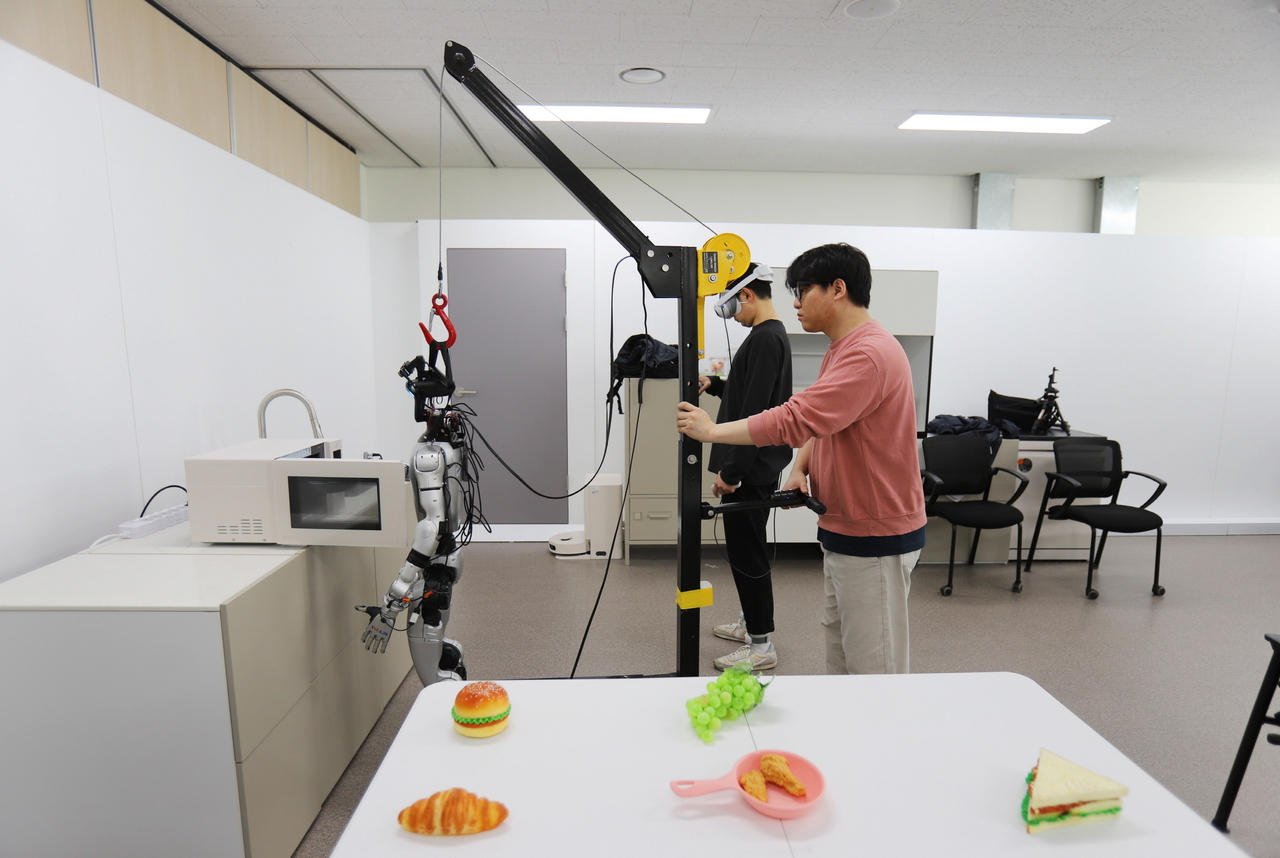
The release is dated 4 November. The ceremony was on 3 November, at the Korea Institute of Machinery and Materials. The group behind the site is the Global TOP Strategic Research Group for Self-Growing AI Humanoids, led by KIMM under Dr Chan Hun Park, with the Electronics and Telecommunications Research Institute. KIMM’s president is Seog-Hyeon Ryu. ETRI’s president is Se woong Park. The institute calls it Korea’s first dedicated data-production facility for bipedal humanoids.
What it does today is teleoperation. The release says human operators remotely control the robots as they perform tasks, and that the movements and the task information are recorded for training. KIMM says it will add robots and tasks over time. Twelve is the number on the floor now. The release does not give a count of hours recorded, a size for the dataset, or a named customer.
At the ceremony the demonstrations were a fridge, laundry, arranging a sofa, and buttons and levers inside a vehicle. KAIROS, which the institute calls a Korean humanoid, was shown doing precise manipulation and imitating a full-body motion. A demonstration at an opening is not a production rate.
Ryu’s line is the ambition, not a result. “Securing large volumes of high-quality robot task data is essential to national technological competitiveness,” he said, and the factory is “an important starting point” for Korea’s own training data. He said industry, academia and research institutes will be let in gradually from the end of 2027, and that the work is meant to speed KAIROS. A date for other people to book the room is not a date the robots stop needing a driver.