Robotics · 28 October 2026 · 4 min read
Gemini Robotics ER 2 is on Google Cloud. The 91 percent is a frame, not a shift
Google put the embodied-reasoning model in public preview on 27 October. It is meant to plan multi-minute robot tasks and call the hardware underneath. The 91.3 percent figure is Google’s score for finding one moment in a video. Boston Dynamics’ quote is about Spot and inspection, not a count of jobs finished.
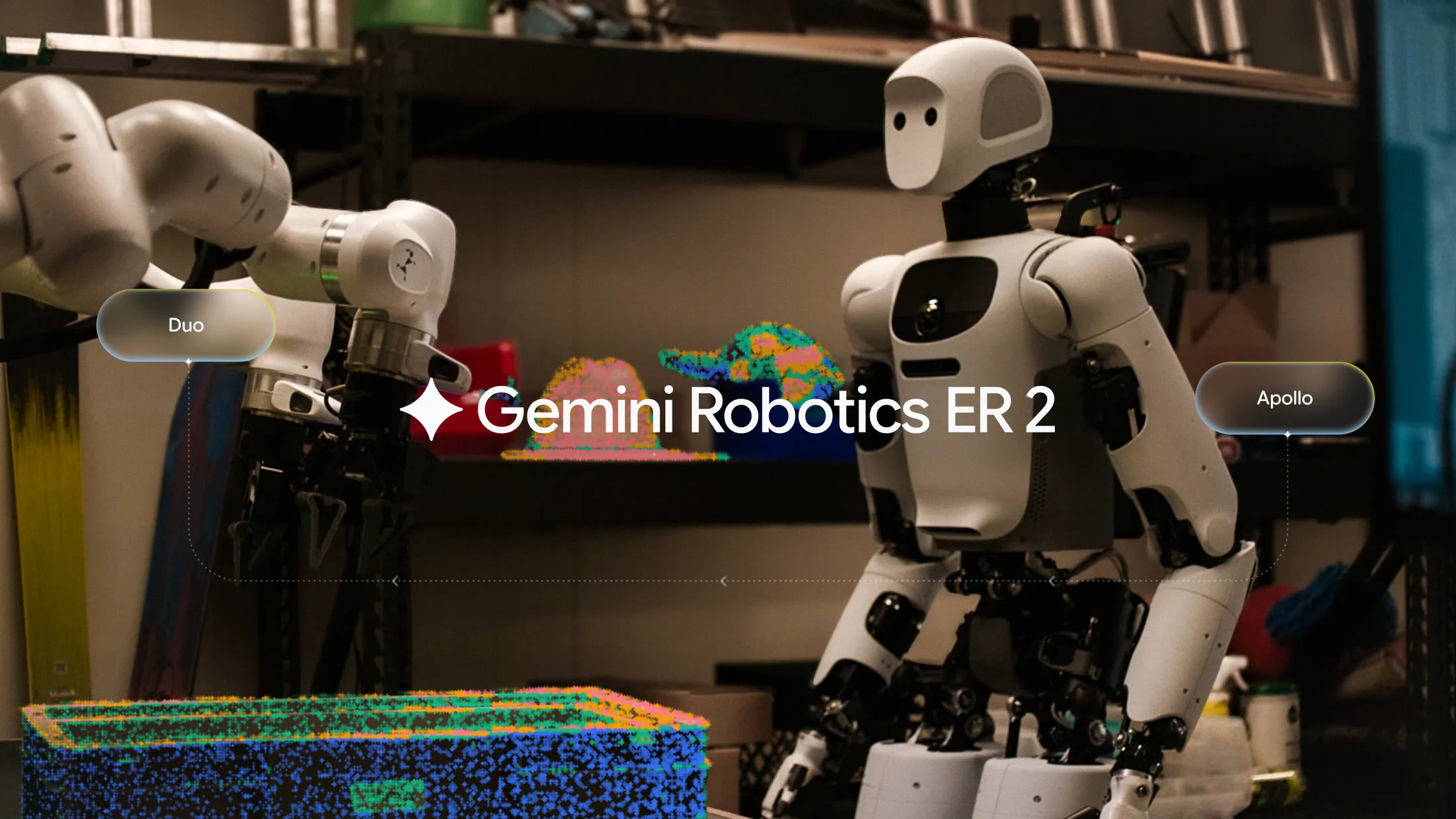
Google Cloud said on 27 October that Gemini Robotics Embodied Reasoning 2 is in public preview on the Gemini platform. The model is the high-level layer of Gemini Robotics 2, which the company introduced earlier this year. Google describes it as a brain that can sit on a fixed arm or a humanoid: it watches video, plans a long task, talks to a person, and calls the lower-level action models and the hardware interfaces. The new fact is that a company can now start that loop from Model Garden, inside Google’s cloud controls, rather than only inside a research demo. A preview is not a general release, and a model that can call an arm is not an arm that has finished a shift.
The number in the post is specific, and narrower than it first looks. Google says the model finds the video frame where a critical event happens, the example given is when to stop pouring, with 91.3 percent accuracy and a mean error of 0.96 seconds, at four times the speed and a fraction of the compute of “many larger model categories.” It does not name those categories, or say how many videos, or what a miss looks like. Finding the moment to stop pouring is a real test. It is not a rate for a warehouse, and it is not the earlier internal result in which Gemini 4 Argon was said to put seven cornhole shots in a row on a real Apollo.
The customers in the post are quotes, not logs. Marco da Silva, who runs Spot at Boston Dynamics, says video changes an inspection: the robot is no longer only checking whether something looks right at one instant. DeepReach and Arm are quoted on training data and on robotics chips. A materials lab, ASTAR IMRE, is quoted on replacing rigid scripts. None of them publishes, in this note, how many robots, how many hours, or what the person still does. The cover image labels an arm as Duo and a humanoid as Apollo. Those are bodies the model is being shown with. They are not a delivery list.
The price is on Google’s table, under the name Gemini ER 2.0. Through 31 December 2026 the listed rates are $1 per million input tokens and $5 per million output tokens, with cached input at $0.10. From 1 January 2027 the table shows $2 and $10, and cached input at $0.20. The page also describes a promotional credit, so the invoice can differ from the list. A buyer can now rent the planner. The post does not say what the robot does when the cloud call fails in the middle of a pour.